The Scene Never Really Disappeared

Everything Is Relative: The Sound of a Generation — Volume 01, Part 6 of 6

It is tempting to tell the story of late-’90s punk and ska as a rise-and-fall narrative. First came the clubs, then the radio hits, then the inevitable decline. That version makes for a tidy documentary. It also misses what scenes actually do.

Musical fashions change, but the networks they create don’t vanish overnight. Bands keep touring. Listeners start bands of their own. Independent venues and labels survive by adapting. A kid who once learned about punk from a skate video may later share the same song with someone who has never touched a VHS tape.

The legacy is audible in contemporary pop-punk revivals, but it also lives outside the sound. The DIY instincts of booking a show, designing a flyer, building a community, and releasing music without waiting for permission are now familiar across many genres. The technology has changed. The impulse hasn’t.

There is a useful caution in nostalgia: memories tend to flatten differences. The ’90s scene wasn’t one big happy family, and not every band sounded alike or shared the same values. Punk, ska, hardcore, and skate culture overlapped without becoming interchangeable. Those disagreements were part of the energy.

Maybe that is why the era still feels alive. It wasn’t just a collection of songs. It was a method of finding people through music—and finding music through people.

The Relativity connection: A movement doesn’t have to stay in the spotlight to keep influencing what comes next.

—
Relativity Radio | Music, culture, and the connections between them.

From the Garage to the Radio

Everything Is Relative: The Sound of a Generation — Volume 01, Part 5 of 6

In 1994, punk’s relationship with the mainstream became impossible to ignore. Green Day’s Dookie and The Offspring’s Smash reached audiences far beyond the clubs and record shops that had helped build the scene. The songs were suddenly on radio, television, and in bedrooms where punk had rarely been heard before.

The success created an argument that never really went away: could punk become popular without losing what made it punk?

It was an awkward question because punk had never been one unified rulebook. For some listeners, independence meant staying outside major-label systems. For others, it meant making the music you wanted, regardless of who distributed it. The Offspring’s Smash, released on Epitaph, complicated any easy claim that independent records couldn’t become huge.

By the end of the decade, melodic punk had become a familiar part of pop culture. Blink-182’s Enema of the State helped push pop-punk further into mainstream visibility. Music videos, movie soundtracks, and alternative radio made the sound seem ubiquitous.

But commercial success didn’t erase the basement shows, small labels, and regional bands still doing their own thing. It created two overlapping realities: punk as mass entertainment and punk as local community. Fans often lived in both at once.

The Relativity connection: The meaning of ‘underground’ changes depending on where you’re standing—and who has just discovered your favorite band.

—
Relativity Radio | Music, culture, and the connections between them.

The Summer Punk Took Over America

Everything Is Relative: The Sound of a Generation — Volume 01, Part 4 of 6

A parking lot in the middle of summer. Asphalt radiating heat. A dozen bands competing with the sound of skateboards, generators, and crowds. For many fans, the Vans Warped Tour felt less like a conventional concert and more like a temporary town.

Founded in 1995, Warped Tour brought punk, ska, hardcore, and related styles together on a traveling festival circuit. Its significance wasn’t only the lineup. It was the proximity. A fan could arrive for one favorite band and leave talking about three others discovered on a smaller stage.

That made the festival a physical version of a mixtape. Established acts and newcomers shared a bill. Merchandise tents doubled as meeting places. Skate culture wasn’t merely decoration; it was part of the event’s identity, connecting the music to a wider youth culture.

There was tension built into the model. Punk had long prized independence and skepticism toward commercial machinery. A sponsored national tour could seem like the opposite of that. Yet the same scale gave smaller bands access to audiences they might never have reached on their own.

Warped Tour didn’t invent the community. It made a sprawling network visible in one place, one sweltering afternoon at a time. And for a generation, the memories of discovering a band are inseparable from sunburn, dust, and the walk between stages.

The Relativity connection: A scene can be scattered across the country and still feel like a hometown when everyone shows up in the same parking lot.

—
Relativity Radio | Music, culture, and the connections between them.

The Little Record Labels That Changed Everything

Everything Is Relative: The Sound of a Generation — Volume 01, Part 3 of 6

Imagine a map of the 1990s punk scene. Instead of highways, draw lines between mail-order catalogs, record stores, all-ages clubs, vans, and bedroom stereos. Now add the independent labels. Suddenly, the map starts to make sense.

Epitaph Records, founded by Bad Religion guitarist Brett Gurewitz, and Fat Wreck Chords, founded by NOFX’s Fat Mike and Erin Burkett, became important gateways for listeners. Their compilations could introduce someone to several bands for the price of one album. For a teenager with limited money and an enormous appetite for music, that was a powerful proposition.

The labels also created a recognizable universe. Artwork, liner notes, logos, and label rosters were clues about what else you might like. Buying one record often meant discovering five more names to investigate. In a pre-streaming world, the label itself could become a trusted curator.

But the ecosystem was never just two California companies. Asian Man Records, Hopeless Records, Vagrant Records, and countless smaller operations helped sustain different corners of punk, ska, and melodic hardcore. The network was messy, regional, and constantly evolving.

There is a paradox here. The same DIY infrastructure that protected independent music also helped some of it become commercially enormous. A distribution network built around community could become a launchpad to the mainstream.

The Relativity connection: A record label can be more than a business. Sometimes it’s the thread connecting people who have never met.

—
Relativity Radio | Music, culture, and the connections between them.

When Punk Learned to Dance

Everything Is Relative: The Sound of a Generation — Volume 01, Part 2 of 6

Punk asks you to push forward. Ska invites you to move sideways. Put the two in the same room and, improbably, you get a dance floor that looks a little like a mosh pit.

The ska revival that broke through in the 1990s was not the second wave of ska. That label usually belongs to Britain’s late-1970s and early-1980s 2 Tone movement, which followed ska’s Jamaican origins. The American boom of the ’90s is more accurately called the third wave. Its musicians drew from those earlier traditions while mixing in punk, pop, and local scenes of their own.

That distinction matters because the story is richer than checkered sneakers and brass instruments. Bands such as Fishbone, The Mighty Mighty Bosstones, Reel Big Fish, Less Than Jake, and Save Ferris approached the crossover from different directions. Some emphasized hard-edged guitars; others leaned into buoyant hooks, humor, or more intricate horn arrangements.

What united the scene wasn’t a rigid sound. It was the permission to combine things that supposedly didn’t belong together. At one show, you might hear a blistering punk chorus followed by a horn line that turned the entire room into a bouncing dance party.

The boom was brief in mainstream terms, but the experiment was lasting. Ska-punk showed that intensity didn’t have to mean grimness. A song could be loud, funny, frustrated, melodic, and irresistibly danceable at once.

The Relativity connection: Two musical traditions can seem worlds apart until a room full of people discovers the same beat.

—
Relativity Radio | Music, culture, and the connections between them.

The Skate Video Was Our Spotify

Everything Is Relative: The Sound of a Generation — Volume 01, Part 1 of 6

A skateboard hits concrete. A guitar kicks in. For the next three minutes, the song and the trick are inseparable. If you were discovering music in the 1990s, that combination could change your taste overnight.

Skate videos weren’t just sports footage with background music. They were mixtapes with moving pictures, passed between friends and watched until the tape wore thin. A video part might introduce a kid in one town to a band playing tiny clubs hundreds of miles away. You didn’t need a record-store employee to make a recommendation. The skater made it for you.

Consider the soundtrack to Welcome to Hell, Toy Machine’s 1996 video, or the music woven through the 411 Video Magazine series. The selections could jump between punk, hip-hop, metal, and sounds that resisted neat categorization. That range mattered. Skate culture wasn’t a single genre; it was a way of finding your own route through several of them.

The connection ran both ways. Fast punk songs made impossible-looking tricks feel urgent. A skater’s style could make an unfamiliar track feel like a personal discovery. Years later, hearing that song could bring back a specific stair set, handrail, or grainy VHS frame.

Streaming services now promise to know what you’ll like before you do. The skate video offered something different: discovery attached to a person, a place, and a moment. It wasn’t personalized by software. It became personal because you lived with it.

The Relativity connection: Sometimes music isn’t remembered for where you heard it. It’s remembered for what you saw while it played.

—
Relativity Radio | Music, culture, and the connections between them.

Wayne Coyne Looks Back on 20 Years of The Flaming Lips ‘Soft Bulletin’

“The record is saying, ‘You’ve got to love life as much as you can, and if something tears some of that away from you then that’s ‘The Soft Bulletin’”

The Flaming Lips faced a pretty uncertain future at the turn of century. It had been a weird decade. But then, weird is just what they do.

After four arty and wonky psych-rock albums were released independently to much acclaim in the late ’80s, they found themselves signed to Warner Bros Records in 1990, back when cigar-chomping record execs were starting to turn grunge and the ‘Alternative Nation’ into big bucks. Alas, these Oklahoma stoners were anything but a cash cow.

Buoyed by the runaway success of college radio banger ‘She Don’t Use Jelly’, 1993’s ‘Transmissions From The Satellite Heart’ finally threatened to catch a little attention and sold a respectable amount, but beyond that their numbers left them in the limbo that they could be dropped at any given moment. Not that they gave too much of a shit.

“We were never that comfortable with the world paying attention to us – especially being on Warner Bros,” frontman Wayne Coyne tells NME. “There was this world of making music videos and needing to sell records and play big concerts – that just wasn’t something that we thought we were very good at.”

A lot of bands in their shoes would have thrown together a couple of quiet-LOUD-quiet-LOUD blasts of late night MTV fodder to keep the moneymen happy, but that would have been the easy way out. While their alt-rock peers were selling out stadiums, the Lips set up a bunch of guerrilla gigs in car parks with frontman Wayne Coyne yelling through a megaphone while messing around with pre-recorded sounds on cassettes played through boomboxes with the help of 40 volunteers.

Guitar wizard Ronald Jones had quit the band due to his agoraphobia and frustrations around the spiralling heroin habit of bandmate Stephen Drozd. Without their guitarist and bored of the post-grunge landscape that surrounded them, they shunned rock from their sound. Instead, they injected some steroids into their boombox show concept to create 1997 “album” ‘Zaireeka’: an art rock experiment of four discs of music that could be played separately, all at once, or in any combination. It was nuts, and their increasingly dubious record label took quite a bit of convincing to put it out.

The hardest part of ‘Zaireeka for them was recording it,” the band’s manager once said in a documentary. “For me, it was getting Warner Bros to put it out.”

They promised to do “a proper record” after “the crazy record” all on one budget.

image: https://ksassets.timeincuk.net/wp/uploads/sites/55/2019/05/GettyImages-688553398_FLAMING_LIPS_2000-1024×650.jpg

The Flaming Lips, in 1999. Credit: Gie Knaeps/Getty Images

With Warners’ interest waning, the follow-up record to ‘Zaireeka was a bit of ‘do or die’ moment, but they also had pestilence and tragedy to contend with. During early sessions for the record, doctors told Drozd that they might have to amputate his whole hand due to what he said was a freak spider bite from the poisonous “fiddleback” (he later admitted it was more likely an abscess from where he’d injected heroin into his hand). The same few months also saw bassist Michael Ivins have a brush with death in a car crash in Oklahoma City when stray tyre barrelled into his car and forced him off the road. Then, Coyne lost his father to cancer.

Liberated by their indulgences on ‘Zaireeka’ and with newfound view on mortality, they emerged with 1999’s bittersweet ‘The Soft Bulletin’ – a symphony of strings, machines and synthetic sunshine.  The single ‘Waitin’ For A Superman’ is Coyne coming to terms with the fact that a miracle to save his father was not forthcoming, ‘The Spiderbite Song’ is child-like lullaby of love from Coyne to his bandmates in the wake of their recent near-misses, ‘Feeling Yourself Disintegrate’ admits that “life without death is just impossible” but worth it for love all the same, and ‘Race For The Prize’ is the glorious set-opener telling of two scientists willing to sacrifice everything to save the world. At the very least, they’d saved themselves.

The Flaming Lips had set their existential musings to what sounded like a cinematic, sci-fi sequel to The Beach Boys’ ‘Pet Sounds’. It worked. The mad scientists finally cracked the mainstream, the critics gave it top marks, and NME named it as 1999’s Album Of The Year.

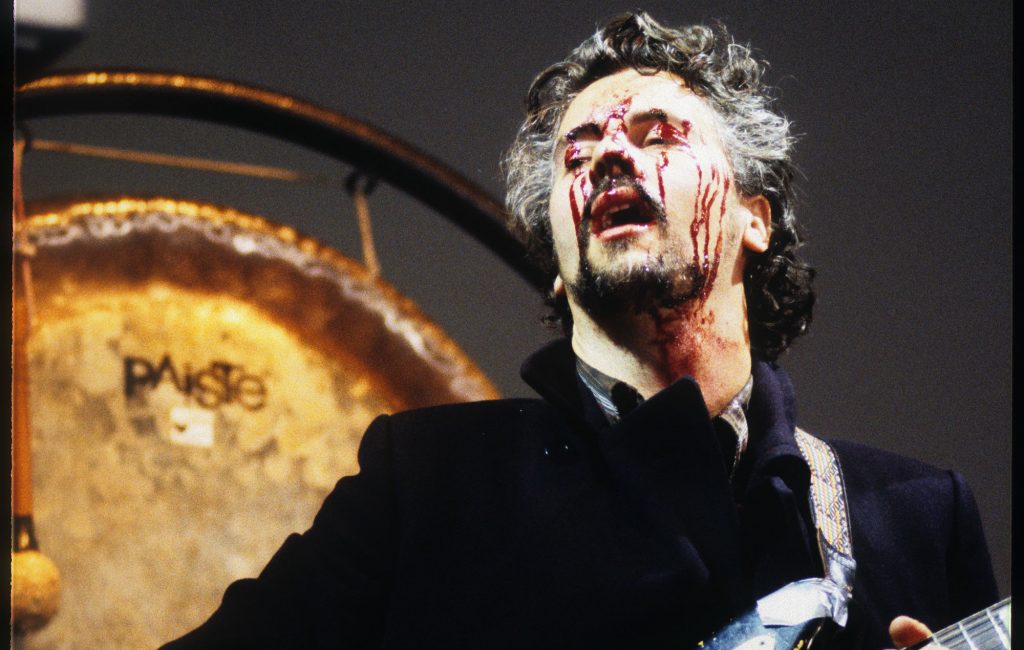
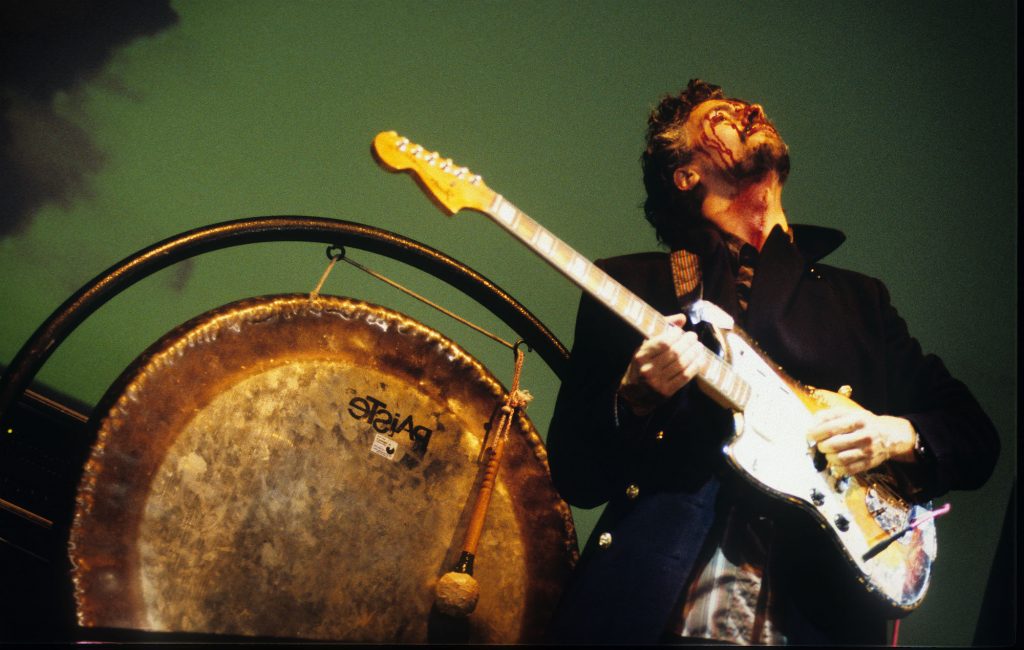
To give the album the theatre it deserved, the subsequent live shows shaped The Flaming Lips into the blood-splattered, balloon-loving, laser-fuelled, animal-friendly, festival headlining freakshow inside a giant bubble that you see today. The band who made the soundtrack for Spongebob Squarepants. The band who got together with Miley Cyrus to explore her freakier side. The band who released one album inside a gummy skull and another featuring Nick Cave’s actual blood. The band who can do what the fuck they want, and all thanks to the gift that is ‘The Soft Bulletin’.

To celebrate the album on its 20th anniversary, we caught up with Wayne Coyne to talk over the seismic impact that the record had on his life and thousands of others.

Hello Wayne. Do you feel a weight around the legacy of ‘The Soft Bulletin’?

“Only now. I don’t think we would have liked that in the beginning. I don’t think we could have made the album if we thought that was going to happen. We’re not those young, innocent guys getting ready to make that transition that ‘The Soft Bulletin’ was about.”

But you see it for what it is now?

“Now we do. Maybe 20 years is a long time to have figured it out, but now the music affects us too. We made it so long ago that there are no longer those muscle memory triggers of the struggles and the failures and all that it takes to make music like that. Now I just hear it and I’m like, ‘Who the fuck made this record? This is a good record! This is cool!’”

“We’re not those young, innocent guys getting ready to make that transition that ‘The Soft Bulletin’ was about” – Wayne Coyne

It’s a life-affirming record that a lot of people have a very profound connection to. Is that a headfuck?

“Yeah. We’re great ambassadors to being the ones who get to stand there and sing these songs, but it’s a strange world. ‘The Soft Bulletin’ is catching us in the transition of going from one mode to another. We knew that at the time; that we weren’t the same people who’d started to make this thing. We knew we couldn’t make another record like that. All we could do was make another record of how we felt at the time.”

A lot has been said over the years that this could very well have been your last album.

“I think ‘Zaireeka’ really freed us up. We got signed to Warner Bros in the early ‘90s, wanting them to succeed but not knowing how to do that. We knew there was a limit to that kind of freedom and we pushed that to the absolute limit when we made the ‘Zaireeka’. We were just looking at the future going ‘If we’re gonna make a record like ‘The Soft Bulletin’, why would they keep us?’”

Was there a very real threat of getting dropped?

“We started to make ‘The Soft Bulletin’ while being very realistic that it could be the last one we ever made. We weren’t event pretending to be aware of commercial viability. We thought that if nothing else, it would stand for us. Nobody can control the music industry but we could control making the record we wanted to. If they kick us off the label then that’s that. There wasn’t a fear of failure, we just had to be sure that we wanted to make it. Once we had that, it gave us even more confidence.”

It also seems like true rebirth of the band. From there on, you’re almost unrecognisable as the band who made ‘She Don’t Use Jelly’.

“When ‘The Soft Bulletin’ came out, we really were just completely oblivious to being like a rock band that people were used to. I didn’t know if it was going to go anywhere. We were starting to play shows and that’s where our originality really surfaced for the first time. We weren’t trying to be a normal band. We didn’t even know what a band like us should be like.”

“There wasn’t a fear of failure, we just had to be sure that we wanted to make it.” – Wayne Coyne 

 So the live shows just became more instinctual?

“We were throwing confetti around, I’d pour blood on my head, and we knew that if you’d come see us we could entertain you. I didn’t know if we were gonna look like any other band you’d seen before but we were going to try and entertain you and see how it goes. Who’d have ever thought that would work? There’s no marketing and there’s no plan.”

image: https://ksassets.timeincuk.net/wp/uploads/sites/55/2019/05/GettyImages-688553408_FLAMING_LIPS_2000-1024×650.jpg

The Flaming Lips, live in 1999. Credit: Gie Knaeps/Getty Images

How much would you say that the album owes to ‘Zaireeka’?

“Part of the thing with The Flaming Lips and the strings, the horns, the timpani – there’s a certain authentic drama about it. Though we were using the most modern synthesizers and digital junk that you could get at the time, we were trying to make it sound like it wasn’t a band any more. We wanted it be more of an emotional sound than a band. I think those things we did on ‘Zaireeka’ freed us from being a band.”

Did that just happen or did you have a very ‘anti-band’ attitude?

“We were trying to say we’re not a band that plays drums or has bass players or guitar players. It was just going to be the sound that accompanied my singing. We didn’t want you to envision what you get when you imagine Led Zeppelin with John Bonham and Jimmy Page and whatever. We didn’t want you to envision anything. You just heard it as music. Whatever you envisioned was this other world.”

But the concept didn’t catch the world’s attention?

“I don’t know if ‘Zaireeka’ did that for other people but it allowed us to just make music. It was just such a technical mindfuck. Some of the best songs on ‘The Soft Bulletin’ were rejects from ‘Zaireeka’ because they just didn’t work. ‘Race For The Prize’ was a reject from ‘Zaireeka’. That’s how insane we were.”

Did you realize the potential what you had on your hands?

“That’s the height of being so obsessed and fucked up on these ridiculous ideas. We were no longer hearing it as music. It wasn’t music, it wasn’t lyrics, it wasn’t chord structures.  We came down from that and we realised that we had these insane tracks that were the best songs we’d ever come up with. Just three months earlier, they were the rejects that we didn’t see the use in putting out. That’s the truth of it. You really do have to be completely in love with what you’re doing and see where it gets you. It doesn’t always get you where you want to go, but it definitely gets you somewhere.”

“It speaks to a certain sensitive person. I don’t think it speaks to a Foo Fighters’ kind of audience.” – Wayne Coyne

The band were dealing with a lot of loss and demons at the time. 20 years later, what would you say the resounding message is of ‘The Soft Bulletin’?

“It speaks to a certain sensitive person. I don’t think it speaks to a Foo Fighters’ kind of audience. When Steven, Dave Friddmann [producer] and I we were making it we were grappling in our minds with the idea that the world is a happy and beautiful place. You know; you’re optimistic and all of this is work for you in your young life. The longer you keep going forward into this beautiful place you start to realise that it’s not really a beautiful place. Bits of it are full of unfair and horrible things. It’s a shift of going from this innocent person saying ‘Anything is possible, everything is beautiful – bring it on. I love life so much’, then having to say ‘Well if you love life so much, what if some of it dies? What are you going to do now?’”

And do you feel that the record answers that question?

“The record is saying, ‘You’ve got to love life as much as you can, and if something tears some of that away from you then that’s ‘The Soft Bulletin’. It’s ‘Oh no’.  If you live, you love and you absolutely throw yourself into it then what if it dies? What choice do we have? Do we live half a life because we don’t want to get hurt so much? Do we love half a love because if might lose it?”

So the bad is ultimately worth it for the good?

“That’s a real thing. We used the words ‘soft’ and bullet’ and ‘in’. It’s like part of you is being executed by something that doesn’t hurt you like a real bullet. It’s a soft bullet. ‘The Soft Bulletin’ is giving you this gentle message. That’s why I say it’s for sensitive people. I think for a lot of people it doesn’t matter that much. Your mind can be filled with other things, but if you’re an innocent person and your mind has that deep connection to love, beauty and family, then you have a lot to lose. You may lose yourself. You may be so devastated by your love for it that you don’t want to live.  Somewhere in there ‘The Soft Bulletin’ was just saying, ‘I know, I know what you mean’. That’s enough. There’s a Daniel Johnston song that goes ‘To understand and be understood’. There’s something in there that let’s you go to the next day.”

“If you live, you love and you absolutely throw yourself into it then what if it dies? What choice do we have?” – Wayne Coyne

You can still hear echoes of ‘The Soft Bulletin’ in a lot of today’s big psych bands. Do you often notice your influence in other artists?

“No, not really. I think people will point it out and go, ‘Oh there’s Tame Impala or MGMT’ but really to us it was the other way around. We loved their music before they even knew who we were. If someone compares Tame Impala or MGMT to us then that’s great. I think they make great and original, crazy music. I’m glad that people would put us in that category, but I don’t think that Steven and I would ever think of it in that way.”

Flaming Lips’ Wayne Coyne

You’ve got these anniversary shows coming up. Do you feel as if you might do this for ‘Yoshimi Battles The Pink Robots’ or your other album?

“Yeah, I do. It’s something that I wanted when I was growing up. I never got to see Pink Floyd or The Beatles, but in my dreams I would have loved to have seen The Beatles play ‘The White Album’. Who wouldn’t, you know? I think we’re very capable of that stuff now. The guys in the group with the technology and all of the shit we have available to us now, it really is great to sing these songs with the arrangements and those kind of sounds.

“As it gets closer, I think we probably will. I don’t know if it has the same emotional power as ‘The Soft Bulletin’, but we’ve played ‘Do You Realize??’ and some of those songs every night since they came out so those songs are always with us. Some it is weird stuff that we’ve never played. But I think so. We like it where we’re not doing ‘the big overview’ of The Flaming Lips’ festival set and it feels different from last night.”

For ‘The Soft Bulletin’ shows, will you be reimagining the songs?

“There’s probably a perception of The Flaming Lips that is probably like The Grateful Dead or Phish or a jam band or something. You know, that we take a song that you know that’s 20 minutes’ long and it becomes a 30-minute jam session. But we really don’t do that. I like it when Jimi Hendrix or Miles Davies does that but I don’t like it in particular for us. With a record like ‘The Soft Bulletin’, that’s not what the music is. We’re always very careful to do the music as well and as familiar as it can be. I know just by talking to people in the audience that they have some very powerful connections to these songs. I’m always aware of that with songs from ‘The Soft Bulletin’.”

The band will return to the UK to perform ‘The Soft Bulletin’ anniversary tour in September.


‘Father of the Bride’ – Vampire Weekend’s Cool Within the Uncool

Vampire Weekend‘s last album, Modern Vampires of the City, helped vault it to festival headliner status, and topped year-end best-of lists when it was released. But that was six years ago — and a lot has happened in the time since. One of the main creative forces in the band, Rostam Batmanglij, left the group in early 2016. While the remaining members focused on side projects, voices in the music industry were beginning to float the idea that guitar rock might have slipped out of relevance. And then, of course, came the 2016 presidential election.

This week, the band returns at long last with its fourth LP, Father of the Bride. Lead singer and guitarist Ezra Koenig joined us to discuss how age, experience and time away have changed his approach to songwriting; addressing politics both on record and onstage with Senator Bernie Sanders; and why, for a group like Vampire Weekend, the decline of guitar rock might not be the worst news.

Ezra Koenig: Growing up, I always liked artists like The Smiths and The Cure: They have some very upbeat, cheerful songs, but it’s such a contrast with the lyrics. That always just made a lot of sense to me — especially if you’re trying to kind of create a snapshot of life as you know it, that every song would have a mixture of joy and pain.

It’s interesting that you bring up the word “suffering,” because at some point, I realized that three of the songs had the word “suffering” in the chorus. The first song we put out, “Harmony Hall,” had this part that went,”I thought that I was free from all that suffering.” Almost like a Buddhist way of thinking: You think you’ve finally figured out a way to be free from suffering, but of course, life is a cycle. But then, I actually changed it to “questioning,” which I think is better for the song.

I like that song because it also gets to this idea a lot of people wrestle with — of people and places that have maybe let you down. I don’t know if I’m reading too much into that line, “Anybody with a worried mind could never forgive the sight / Of wicked snakes inside a place you thought was dignified.”

No, I think that’s a fair interpretation. And yeah, also trying to come to terms with the idea that not only can it be painful or disorienting when an institution or a group or something lets you down, but that that’s almost built into the fabric of reality, and you can’t be shocked by it every time that it happens.

But we all have been, right? I mean, I haven’t had a soundtrack for that emotion. But the feeling that there is corruption in this place, or ugliness in this place, and how do I reconcile with that?

Yeah, that’s the funny thing. I always think about high school and college and reading books — from 100, 200, a thousand years ago, 2,000 years ago — where people are more or less saying the same thing about the cyclical nature of government, politics, even just individual pain and suffering. You read all that stuff when you’re a kid and yet you’re still a little bit surprised when you feel it in a personal way or a generational way or a national way. As much as we’ve been prepared for it by the wisdom of the ancients, it still is always shocking.

[With] “This Life,” that was the inspiration for the opening lines: “Baby, I know pain is as natural as the rain / I just thought it didn’t rain in California.” You know all these things are lurking out there, and you still weep. Maybe we all have this gambler’s nature, that we’re going to be the one who bets big and wins big despite the obvious risks.

This also gets to a question I have about trying to write songs that nod to the political, that engage in the ideas of the moment, and that still feel timeless. Because not everyone’s doing it — just being honest, I’m not turning on the radio and feeling that. I may also be asking because you guys appeared with Bernie Sanders during the 2016 campaign. Taking that extra step to stand shoulder to shoulder with a politician is a significant moment.

Yeah, it’s funny: When I talk about it now, people say, “You really put yourself out there.” I really try to think back to how I felt in 2016 — and for me, growing up on the East Coast, New York, New Jersey, when I look at somebody like Bernie Sanders, this older, crunchy, independent senator from Vermont, he truly seemed to me like the least controversial candidate on Planet Earth. The first time we played with him was in Iowa, so early, early days of the primaries. The idea of really sticking our neck out, it didn’t even occur to us — like, “Who could have an issue with this guy? Maybe he won’t win; maybe he’s a little too left of center. But he just seems like the kind of guy everybody likes.”

Of course, I was deeply wrong about that. In retrospect, I kind of see that, obviously, the divisions in politics, particularly within the Democratic Party, are very intense. But I promise, when we first got up there with Bernie, it just felt like the most laid-back political thing you could possibly do.

I read a quote where you said, “With regards to songwriting, everyone’s identity defines how they think about life.” You were saying you don’t get frustrated when people don’t like the band because of your voice or something in the sound, but when they look at it through that accusation of whiteness or privilege or something like that — rather than who you are in particular.

There were elements that I think we all felt when the band started that we were a little bit blindsided by. I always had a sense of humor about preppiness and the Ivy League; I went to Columbia, but I also had student debt and scholarships to pay for it. But the particular identity of Jewish people, which is my background, is not particularly pleasant for people to talk about — it gets fraught very quickly. In the interview you’re referencing, we were talking about a song that’s called “Jerusalem, New York, Berlin,” so it’s not surprising people might want to look at it through the lens of identity. But my point was kind of just like, if you want to go there, you maybe do have to talk about Jewishness and the relationship of Jewishness and whiteness. But, you know, that creates a real can of worms in the current political climate, I think.

It does. I appreciate you saying that it’s not an easy thing to talk about. I mean, in that song you reference, towards the end there’s is a line about that “genocidal feeling that beats in every heart.”It’s serious language.

Yeah, it’s serious language, and it’s also a song. If I wanted to make a direct, simple statement about what it means to be Jewish — what it means to be white, the relationship of America to Israel, Zionism, anti-Zionism — I could go on Twitter. That’s there. There’s a part of me that feels protective of the world of songwriting — to let it lie for a second, you know? To let it be open.

I’ve always felt so connected to Irish folk songs. There’s one called “The Minstrel Boy” that’s about the boy who plays music along with the army, and there’s this line that says, ” ‘Land of Song!’ said the warrior bard / ‘Tho’ all the world betrays thee.’ ” That always struck me, that “the whole world betrays” the land of song. There’s something so sad about that.

We demand a lot — “we” meaning the audience.

Yeah, and that maybe it’s about letting the land of song live on its own terms. It sounds corny when I say it — but the land of song as being someplace that is a little bit separate from the daily battles that we face.

You had a very funny quote to The Times of London: “Guitar acts in 2019 have an irrelevance I’ve come to enjoy.” Which is a joke, but not wrong, in a way.

[Laughs] Well, yeah. I mean, being gone for six years, you watch a lot come and go. I saw there were these big questions being asked: “Is guitar music dead? Is indie music irrelevant?” And I saw the way that it caused stress and anxiety in many of my peers about their place in the world. Maybe that happens every time a wave crests — people get nervous.

But can I ask a question? The idea of irrelevance is not always about, “Is this sound cool? Is this the sound of now?” Is it also that that music stopped speaking to people about their lives in a way that felt relevant? Like, rock fell down on the job?

Maybe. But even beyond that, things come in and out of fashion. At some point, guitar seems like a funny old instrument, and other times it seems more charming or more exciting. I almost felt happy that as I started working on the record the question had been answered: “It’s not particularly relevant. Good. Stop worrying about it.”

We know that there’s people who write poetry, opera, abstract expressionist painting, whatever — art forms that, by one way of looking at it, had their moments of relevance a very long time ago. And yet, we’re often surprised by somebody who’s dedicated to an art form and pulls out an idea that speaks to us. I think as you get older you realize you just just can’t sweat it. There’s almost something pleasant about just being like, “Yes, it’s irrelevant — now, can we talk about how to get the guitar sounding good?”

People are comparing some of the songs on this album to Phish, with the album art having kind of a hippie vibe.

Which I love.

And which is funny, because you guys were called too ivory tower, not punk enough. And now this album comes, and it’s kind of like you’re embracing your uncool impulses.

Every Vampire Weekend album, going back to the start, starts with something uncool. That’s where the action’s at, in my opinion. It’s not like preppiness was cool. Even the attraction to boat shoes and Oxford commas was not particularly cool. But there’s something attractive, sometimes, about looking for the cool within the uncool.

New Long Format Shows in June!

We can’t believe that it is almost June 2019 already! The Relativity crew has been working hard to create some of the very best new long-format shows to date & you will not be disappointed.

We have shows about video game music & the behemoth of an industry it has become. We have coverage & interviews with the people who run the best new(ish) jazz club in Los Angeles, and the whole scene that is still alive and well.

The show we are most excited about, though is the main event – the skate-punk explosion of the late 90’s / early aughts, the bands that made it all happen, and where they are now. The excitement for this probably gives some indication to the ages of the people who run Relativity, but that was our era & shaped a lot of what we do now. We’ve covered some shows, interviewed some of the main players in that genre, and dug deep into the whole scene. It’s going to be epic!

The Ambitious Players In Reno’s Music Scene

Reno’s music scene boasts some ambitious players.

Some of them spend a lot of their time on the road, playing for international names like Jack Johnson, Eddie Vedder, and Nahko and Medicine For the People. And when they’re not on tour, they’re busy making their own music — sometimes with renowned artists from outside Nevada.

It’s just another facet of an increasingly dynamic music scene, and David Hadel — the afternoon host at NV89, Nevada Public Radio’s music station in Reno — is helping expose it.


Adam Topol – “Reno” “Hollow”

“In the past, he’s played drums with acts like Eddie Vedder, Joey Santiago and Ziggy Marley, and he’s currently the touring drummer for Jack Johnson. But he’s played with legends like Jimmy Cliff and David Gilmour, from Pink Floyd, as well.

After having played alongside so many musicians in the past, it [was] hard for him to come up with his own material. This latest record he released a couple of years ago, Regardless of the Dark, took him about three years to write it. But the final result was 10 songs that go from ‘Brazil’ to ‘Reno.’”

Tim Snider – “Hurricane”

“He’s more exclusively a violinist. When he’s playing on stage himself, he likes to use a loop pedal where he loops violin, guitar, cajón, even looping his own vocals and harmonizing with them to create this huge wall of sound. He kind of reminds me a little bit of Andrew Bird, if you’re familiar with his violinist style. He doesn’t do a lot of picking like Andrew Bird does. But he has more of a folky, sort of a Dispatch vibe to him.

Right now, he’s the touring violinist for Nahko and Medicine for the People.”

Moondog Matinee – “Ghost Dime”

“When you see Moondog Matinee perform on stage — and they’ve [played everywhere] from here in Reno down to Vegas for the Life is Beautiful festival — they put on a heck of a live show. The lead singer, Pete Barnato, [has] got this big fedora looking hat with a feather in it. And they’ve got this James Brown kind of flare and they just tear up the entire stage. Even if it’s a small or a big stage, they use all of it when they perform.

They have this Joe Cocker, ’70s rock feel, with a little new-vibe twist as well.”

Dead Winter Carpenters – “Roller Coaster”

“So Dead Winter Carpenters is a five-piece Americana bluegrass band from North Tahoe and just last year they collaborated with Jackie Greene on their song “Rollercoaster” — and he’s not predominately playing lead guitar like he had with The Black Crowes a few years ago. He’s actually playing a Hammond B-3 organ on this particular track.”